
Forget model.eval() and Your Accuracy Depends on Your Traffic
Last week’s post ranked the damage from preprocessing bugs — the glue code in front of the model. Today is the other classic inference mistake, the one inside the serving code itself: forgetting model.eval(), and its sibling, forgetting torch.no_grad(). Every PyTorch tutorial recites these two lines; almost none of them show what actually happens when you omit them. Having a trained CIFAR-10 model (89.51% in correct eval mode) still warm from last week, I measured it.
The punchline is worth stating up front, because it’s the mechanism that makes this bug genuinely nasty rather than merely embarrassing: the damage is a function of your serving batch size. The same forgotten line costs you everything or nearly nothing depending on how many requests you happen to bundle together — and the direction of that dependence is precisely backwards from how software gets tested.
What train mode actually changes
model.train() vs model.eval() toggles two behaviors. Batch norm layers switch between normalizing with the current batch’s statistics (train) and the running statistics accumulated during training (eval). Dropout switches between randomly zeroing activations (train) and passing everything through (eval). A model left in train mode at inference doesn’t crash, warn, or log — every output is a well-formed probability distribution. It’s just computed with the wrong math.
The batch-size table
Evaluating the frozen model in train mode, batching the (shuffled) test set at different sizes:
| serving batch size | accuracy |
|---|---|
| 1 | 10.00% |
| 2 | 60.00% |
| 4 | 74.51% |
| 16 | 85.73% |
| 64 | 88.15% |
| 256 | 89.09% |
| (correct eval mode) | 89.51% |
At batch 1, the model scores exactly chance — batch norm with a single sample normalizes each feature map by its own statistics, obliterating the scale and shift information the network learned to rely on. At batch 2 it claws back to a coin flip and a half. And by batch 256, train-mode inference sits 0.42 points below correct — a deficit indistinguishable from noise unless you were looking for it.
Now overlay how services get tested. Offline evaluation scripts and load tests process big comfortable batches — 256, 512 — where this bug costs a third of a point and passes every check. Production traffic, especially early, arrives as single requests: batch size one, where the same code is a random number generator. The better your throughput-oriented testing, the better this bug hides. It is the only bug I’ve measured on this blog whose severity is inversely proportional to how hard you test for it.
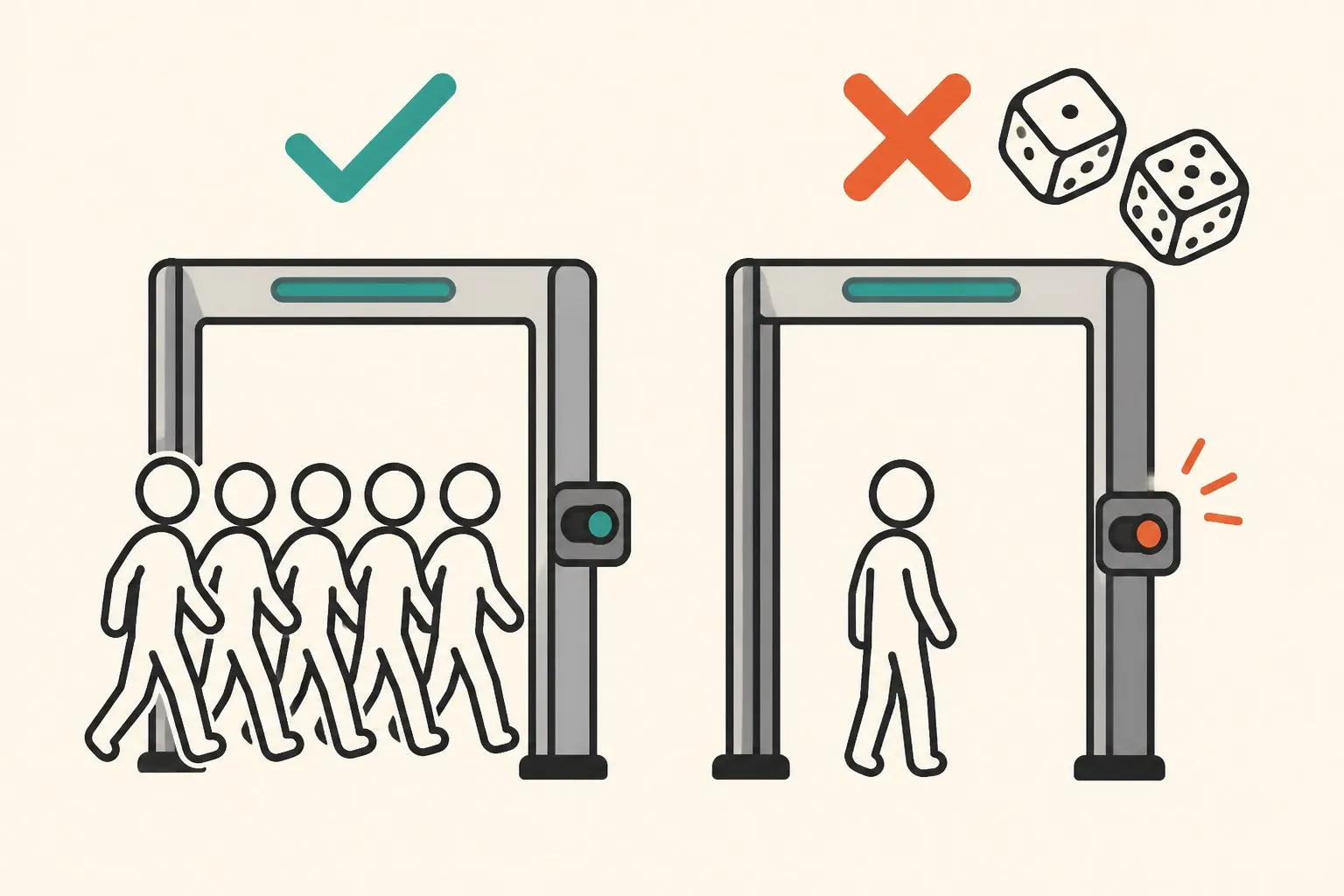
Two quieter consequences ride along with the headline. First, in train mode your outputs for a given image depend on the other images in the batch — the batch statistics are shared — so identical requests return different answers depending on their neighbors, which from a client’s perspective is nondeterminism with no visible source. Second, train-mode batch norm keeps updating its running statistics while serving: the model rewrites itself with every request. I measured one pass of train-mode “serving” over the test set, then switched back to proper eval mode — accuracy had drifted from 89.51% to 89.12%. Same-distribution traffic cost 0.4 points of permanent damage; production traffic that drifts from the training distribution would steer the statistics correspondingly further. A bug that corrupts state, not just outputs.
For completeness I also trained a variant with dropout (p=0.3) and served it in train mode at large batch: 89.26% became 88.30%, with repeated shuffled evaluations wandering across a ~0.2-point band from the random masks. Dropout-left-on is real but survivable — a point and some jitter. The catastrophic component of forgotten eval() is batch norm, and specifically batch norm meeting small batches.
no_grad: the other line, and what it’s actually for
torch.no_grad() folklore says “faster inference.” Measured on batch-512 forward passes: 7.82 ms with, 7.86 ms without. No speed difference worth naming — the forward math is identical either way. What changed is memory: 479 MB peak with no_grad, 2,224 MB without. Autograd, preparing for a backward pass that will never come, retains every intermediate activation in the graph; at batch 512 that’s 4.6x the footprint, scaling with batch size and model depth. The failure mode isn’t slowness — it’s an inference server whose memory usage quietly quadruples, OOMs under a traffic spike, or leaks steadily if outputs (each dragging its graph behind it) get accumulated into a list. torch.inference_mode() is the stricter modern spelling of the same idea, and what I use in new code.
The two-line defense for the two-line bug
Everything in this post is preventable with asserts that cost nothing: at the top of the serving entrypoint, assert not model.training, and construct outputs under inference_mode. And the golden-sample test from last week catches this whole class too, with one amendment I’d now consider mandatory: include a batch-size-1 golden sample. A batch-256 golden check would have signed off on the 89.09% impostor; the single-image check fails it instantly and unmissably, at 10% accuracy.
Ranked against the whole deployment series, forgotten eval() at batch 1 is now the single most destructive mistake I’ve measured — worse than any preprocessing bug, seventy-nine points below baseline, from one absent line that every tutorial warns about and every codebase eventually omits anyway. The warnings clearly aren’t the bottleneck. The tests are.